The strategic arrangement of a home water filtration system shapes daily health routines, affects the longevity of plumbing infrastructure, and determines how safely families access clean drinking water every day. Modern purification technology effectively removes harmful contaminants, chemicals, and sediment, ensuring every faucet delivers high-quality water. Investing in a reliable system promotes wellness while reducing environmental waste.
While modern municipal treatment has significantly reduced waterborne pathogens, it has introduced a new generation of "invisible" threats: aging lead infrastructure, disinfection byproducts (DBPs), and the persistent presence of "forever chemicals" known as PFAS. Ensuring water safety is no longer a passive act of trusting the utility company; it is an active discipline of residential monitoring and targeted filtration. This guide explores the technical nuances of water contaminants, the mechanics of modern filtration technologies, and the strategic steps every homeowner must take to engineer a robust hydration sanctuary.
Understanding the Modern Contaminant Profile
To protect your household, you must first identify the enemies that are invisible to the naked eye. Contaminants in the 21st century fall into three primary categories, each requiring a specific defensive strategy.
1. Chemical Residuals (The "Forever" Threat)
PFAS (Per- and polyfluoroalkyl substances) have gained international notoriety for their persistence in the environment and the human body. These synthetic chemicals, used in non-stick coatings and firefighting foams, are linked to endocrine disruption. Alongside these are disinfection byproducts , such as trihalomethanes, which form when chlorine reacts with organic matter in the water during the transit from the treatment plant to your tap.
2. Heavy Metals and Infrastructure Leaching
Even if the water leaving a plant is pristine, it may travel through miles of lead-jointed pipes or brass fixtures. Lead and copper leaching is a localized threat that can vary significantly from house to house based on the age of the internal plumbing and the acidity of the local water supply.
3. Biological and Mineral Load
For those on private wells, nitrates from agricultural runoff and coliform bacteria remain primary concerns. Meanwhile, "hard water"—high concentrations of calcium and magnesium—may not be a direct health threat but acts as a "structural tax," destroying appliances, clogging showerheads, and reducing the efficiency of water heaters.
The Mechanics of Defense: Choosing the Right Filtration Technology
No single filter can remove every contaminant. Building an effective system requires matching the technology to the specific chemical profile of your water.
Activated Carbon: The Adsorption Specialist
Carbon filtration is the most common residential technology. It works through adsorption —a process where contaminants stick to the vast surface area of the carbon pores.
The Nuance: While standard activated carbon is excellent for removing chlorine, Catalytic Carbon is required to remove chloramines (a mix of chlorine and ammonia) which many municipalities now use for its long-term stability in the pipes.
Reverse Osmosis (RO): The Molecular Gatekeeper
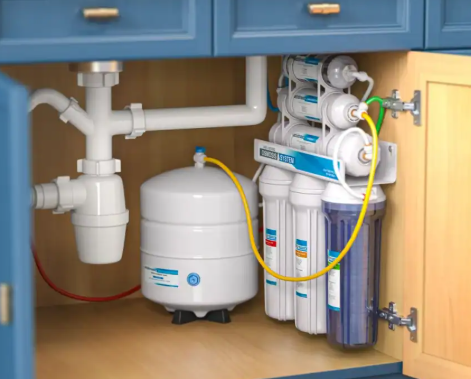
RO systems use a semi-permeable membrane to strip water of almost all dissolved solids. It is the gold standard for removing nitrates, lead, and PFAS.
Pro Tip: RO water is so "hungry" (de-mineralized) that it can sometimes taste flat. High-end systems include a re-mineralization stage that adds trace amounts of calcium and magnesium back into the water for a crisp, alkaline finish.
Ion Exchange (Water Softeners)
Water softeners replace calcium and magnesium ions with sodium or potassium ions. While this protects your plumbing from scale buildup, it does not remove chemical toxins. In a professional layout, a water softener is usually the "pre-treatment" stage, followed by a carbon or RO system for drinking water.
Ultraviolet (UV) Sterilization
For well water, a UV lamp is a critical safety layer. It does not "filter" the water but rather scrambles the DNA of bacteria and viruses, rendering them unable to reproduce. It is a chemical-free way to ensure biological safety without adding chlorine to your private supply.
The Certification Standard: Decoding NSF/ANSI Labels
In the world of water filtration, marketing claims can be misleading. To ensure a filter actually performs as promised, you must look for independent certifications from the NSF (National Sanitation Foundation) or the WQA (Water Quality Association) .
NSF/ANSI 42: Covers "aesthetic" effects like chlorine, taste, and odor.
NSF/ANSI 53: This is the critical standard for "health" effects, covering heavy metals like lead and volatile organic compounds (VOCs).
NSF/ANSI 58: The specific standard for Reverse Osmosis systems.
NSF/ANSI 401: A modern standard for "emerging contaminants," including trace pharmaceuticals and BPA.
Strategic Monitoring: The "Annual Audit"
Water quality is dynamic. Construction in your neighborhood, seasonal agricultural cycles, and even local seismic activity can shift your water’s chemistry.
1. The Annual Professional Test: For well owners, an annual lab test for nitrates and bacteria is a safety mandate. For municipal users, a test every 2–3 years focusing on lead and DBPs is recommended.
2. The TDS Meter: A Total Dissolved Solids (TDS) meter is an inexpensive tool that provides a baseline of mineral concentration. While high TDS doesn't always mean "unsafe," a sudden spike in your reading indicates that your filter membrane may have failed or been bypassed.
3. Consumer Confidence Reports (CCR): If you are on municipal water, you are legally entitled to an annual CCR. This report discloses the average levels of regulated contaminants detected in your city's water system over the past year.
Maintenance: Avoiding the "Filter Fatigue" Trap
The most dangerous filter is one that has exceeded its lifespan. A saturated carbon filter can undergo "desorption," where it suddenly releases a high concentration of the very chemicals it was meant to trap.
Smart Monitoring: Modern systems use flow meters rather than simple timers. A timer assumes you use a fixed amount of water every day; a flow meter tells you exactly when the carbon’s adsorption capacity has been reached.
Sanitization: RO systems and UV housings require annual sanitization. Biofilms can grow inside storage tanks if they are not cleaned, leading to a "musty" taste despite the filtration.
Beyond the Tap: Whole-House vs. Point-of-Use
Should you filter the water at the kitchen sink or where the water enters the home?
The Whole-House (Point-of-Entry) Advantage: Chlorine is not just a threat when swallowed; it is a threat when inhaled. In a hot shower, chlorine and DBPs vaporize into the air. A whole-house carbon tank removes these chemicals before they reach your showerhead, protecting your skin, hair, and respiratory system.
The Drinking Water (Point-of-Use) Advantage: For targeted toxins like PFAS and lead, a high-quality RO system under the kitchen sink is more cost-effective and provides a higher level of "polishing" than most whole-house systems can manage.
Modern Safety Tips: Protecting Your Household Every Day
Beyond filtration, daily habits play a role in water safety.
The "Morning Flush": If your water has been sitting in the pipes overnight, the concentration of lead or copper is at its peak. Run the cold water tap for 30–60 seconds before using it for drinking or cooking.
Cold Only for Cooking: Never use water from the hot water tap for drinking or making baby formula. Hot water is more corrosive and leaches metals from your plumbing and water heater significantly faster than cold water.
Aerator Maintenance: The small screens at the end of your faucets can trap tiny particles of lead or sediment. Unscrew and clean them every few months to prevent them from becoming a persistent source of contamination.
Conclusion
Home water safety is the cornerstone of residential resilience. As our environmental landscape changes and new industrial chemicals enter the water cycle, our defensive strategies must evolve. Investing in home water filtration is not an admission of a failing system, but an acknowledgment of a complex one. By combining certified filtration technology with regular monitoring and smart maintenance, you transform your home into a fortress of health. Ultimately, the peace of mind that comes from knowing every glass of water is pure is one of the most significant investments you can make in your long-term well-being.