We often discuss indoor comfort in terms of temperature, yet temperature is only half of the atmospheric equation. The "invisible" component—humidity—is the true arbiter of how a home feels, smells, and sustains its inhabitants. Achieving the perfect equilibrium requires a sophisticated understanding of air quality and modern ventilation. By balancing moisture levels, families can prevent structural damage, eliminate hidden allergens, and create a revitalizing sanctuary. Mastering this hidden element ensures your living space remains healthy, energy-efficient, and exceptionally comfortable regardless of the changing seasons outside.
Managing household humidity is not merely a matter of comfort; it is a discipline of building science. In an era of increasingly airtight, energy-efficient homes, natural moisture regulation has been compromised. This guide explores the technical nuances of indoor psychrometrics and provides a strategic roadmap for maintaining the "Goldilocks Zone" of humidity: the 30% to 50% range where human health and home durability thrive.
The Science of "Relative" Humidity: Why 50% Matters
To manage humidity, one must first understand that it is "relative." Relative Humidity (RH) measures how much water vapor is in the air compared to the maximum amount the air could hold at that specific temperature. Warm air is like a large sponge; it can hold vast amounts of moisture. Cold air is like a small sponge; it reaches saturation quickly.
When the RH exceeds 60%, the home becomes a biological incubator for mold spores and dust mites. Conversely, when it drops below 30%, the air becomes predatory, actively pulling moisture from your skin, mucous membranes, and wooden furniture. Understanding this balance is the first step in moving from reactive "comfort seeking" to proactive "atmospheric management."
The Biological Impact: Health, Allergens, and Pathogens
The human body is finely tuned to specific moisture levels. When we drift outside the optimal 30–50% RH window, our biological defenses weaken.
1. The High-Humidity Risk: High moisture levels lead to the proliferation of *Aspergillus* and *Penicillium* molds. Beyond the visible stains on drywall, these fungi release mycotoxins into the air. For individuals with asthma or allergies, high humidity acts as a "force multiplier" for respiratory distress.
2. The Low-Humidity Risk: In winter, "dry air" is often the culprit behind chronic nosebleeds, itchy skin, and increased susceptibility to viruses. Research indicates that many viruses, including influenza and certain coronaviruses, remain infectious longer and travel further in dry air, as the lack of moisture prevents respiratory droplets from settling quickly.
3. The Dust Mite Threshold: Dust mites—the leading cause of indoor allergies—require an RH of at least 50% to survive. By maintaining your home at 45%, you create a hostile environment for these pests without the need for chemical intervention.
Structural Integrity: How Moisture Attacks the Home
Your home is a collection of porous materials—wood, drywall, textiles, and masonry. These materials are hygroscopic , meaning they expand and contract based on the moisture content of the air.
Hardwood and Millwork: When humidity fluctuates wildly, wood flooring can "cup" (edges rise) or "gap" (spaces appear between planks). Over time, these cycles of expansion lead to permanent structural degradation and squeaking.
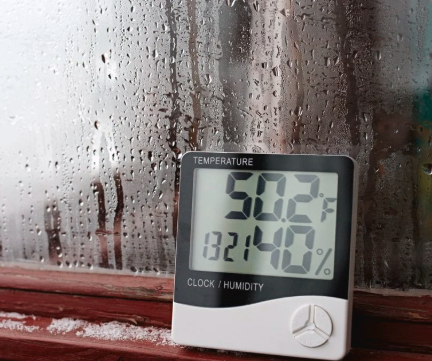
Condensation and "Interstitial" Rot: The most dangerous moisture is the kind you cannot see. When warm, moist indoor air hits a cold surface (like a window pane or the interior of a poorly insulated wall), it reaches its Dew Point and turns into liquid water. This leads to "interstitial mold"—rot that occurs inside the wall cavities, often undetected until structural failure occurs.
Musical Instruments and Art: Pianos, violins, and oil paintings are exceptionally sensitive to RH. A drop of 20% humidity can detune a piano or cause microscopic cracks in the varnish of an heirloom.
The Modern Kitchen and Bath: Moisture Ground Zero
The two most significant contributors to indoor moisture are the kitchen and the bathroom. Managing these areas requires a combination of mechanical ventilation and behavioral changes.
The Mechanical Solution: The CFM Standard
The effectiveness of a bathroom fan is measured in CFM (Cubic Feet per Minute) . A common mistake is installing a fan that is underpowered for the room's volume. A general rule is 1 CFM per square foot of room space.
Pro Tip: Fans should remain on for at least 20 minutes after a shower to fully evacuate the residual steam trapped in towels and rugs.
The Kitchen Dynamics
Boiling water and gas combustion release significant amounts of water vapor.
Source Capture: Always use the range hood when boiling water. If your hood merely "recirculates" air through a charcoal filter rather than venting it outside, it is effectively useless for humidity control. In such cases, cracking a window during cooking is a necessary compromise.
Seasonal Strategies: Winter Desiccation vs. Summer Saturation
Humidity management is a seasonal tug-of-war.
Winter: The Humidification Challenge
Heating systems—particularly forced-air furnaces—kill indoor humidity.
Whole-House Solutions: Bypass humidifiers integrated into the HVAC system are the gold standard, providing consistent moisture throughout every room.
Evaporative vs. Ultrasonic: If using portable units, evaporative humidifiers are generally safer as they do not aerosolize minerals from tap water into "white dust," which can irritate the lungs.
Summer: The Dehumidification Challenge
Air conditioners are, by design, dehumidifiers. They cool the air by removing moisture. However, in "shoulder seasons" (where it is humid but not hot), the AC may not run long enough to remove sufficient moisture.
Dedicated Dehumidifiers: For basements or humid climates, a dedicated dehumidifier with a humidistat (which turns the unit off when the target is reached) is essential.
The Drain Hose: Always use the continuous-drain option if possible. A dehumidifier that stops running because its bucket is full at 2:00 AM is failing its primary mission during the most humid hours of the night.
Technological Integration: Monitoring and Automation
You cannot manage what you do not measure. The modern homeowner should move beyond "guessing" the humidity levels.
1. Digital Hygrometers: These are inexpensive and should be placed in "problem areas" like the basement, the master bedroom, and the kitchen.
2. Smart Thermostats: Devices like Ecobee or Nest can often sense humidity and can be wired to control "over-cooling"—running the AC specifically to lower humidity even if the temperature target has been met.
3. Smart Plugs and Sensors: You can create an automated "loop" where a smart sensor triggers a portable dehumidifier to turn on only when the RH crosses 55%.
Passive Moisture Control: Plants and Materials
While mechanical systems do the heavy lifting, passive strategies provide the finishing touches.
Botanical Regulation: Certain plants, such as Peace Lilies and English Ivy, can absorb a small amount of moisture through their leaves. However, be warned: over-watering a large collection of houseplants can actually *increase* indoor humidity significantly.
Breathable Materials: Using lime plasters or "clay paints" in interior design can provide a natural moisture buffer. These materials are "vapor-open," meaning they can absorb excess moisture during a humid day and release it slowly when the air dries out—a process known as moisture buffering .
Conclusion: Achieving Atmospheric Equilibrium
Managing household humidity is an ongoing dialogue between the outdoor environment and your indoor lifestyle. It requires an understanding of how our daily habits—from the length of our showers to the way we heat our rooms—impact the delicate balance of water vapor around us.
By investing in accurate monitoring, ensuring robust mechanical ventilation, and understanding the seasonal needs of your home’s structure, you move beyond mere comfort. You create a residence that is a true sanctuary: a space that protects your health, preserves your assets, and provides a consistently refreshing atmosphere. In the quest for a perfect home, mastering the hidden atmosphere of humidity is the ultimate final step.