In the hierarchy of household anxieties, fire often ranks high, yet our preparation remains dangerously superficial. Most homeowners view fire safety as a binary state: either you have a smoke detector, or you don't. However, as residential architecture and interior materials have evolved, so has the nature of fire itself. In the 1970s, the average time to escape a house fire was approximately 17 minutes; today, due to the prevalence of synthetic materials and open-plan designs, that window has shrunk to less than three minutes.
Fire safety awareness in everyday settings is no longer just about avoiding open flames—it is about managing energy, understanding material science, and engineering a "survivable environment." This guide moves beyond the basics to explore the hidden vulnerabilities of the modern home and provides a strategic blueprint for comprehensive protection.
The Anatomy of Modern Hazards: The Synthetic "Fuel Load"
The primary reason fire behavior has changed is the "fuel load" of the modern home. In previous decades, furniture was primarily made of wood, cotton, and wool. Today, our living rooms are filled with polyurethane foam, polyester fabrics, and plastic polymers. These materials are essentially "solid petroleum."
When synthetic materials ignite, they undergo pyrolysis —a chemical decomposition that releases thick, toxic black smoke containing hydrogen cyanide and carbon monoxide. This creates a "flashover" condition much faster than natural materials would.
Actionable Strategy: When purchasing furniture, look for labels indicating compliance with TB 117-2013 (a standard for fire retardancy in upholstered furniture) and prioritize natural fibers like wool or leather where budget allows, as these have higher ignition temperatures.
The Silent Threat: Lithium-Ion Battery Thermal Runaway
The most significant new fire hazard in the 21st century is the lithium-ion battery. From smartphones and laptops to e-bikes and cordless vacuums, our homes are dens of stored chemical energy.
When a lithium-ion battery is damaged, overcharged, or exposed to heat, it can enter a state called "Thermal Runaway." This is a self-heating cycle that leads to an explosion and a fire that is nearly impossible to extinguish with standard water-based extinguishers because the battery produces its own oxygen as it burns.
High-Value Safety Protocols:
The Charging Rule: Never charge high-capacity batteries (like those for e-bikes) near your primary exit route. If a fire occurs, it will block your only way out.
Device Health: If a battery begins to bulge (the "pillow" effect) or feels excessively hot, it is a chemical ticking time bomb. Cease use immediately and dispose of it at a certified hazardous waste facility.
Smart Charging: Avoid "overnight charging" on soft surfaces like beds or sofas, which trap heat and increase the risk of internal short-circuits.
Kitchen Dynamics: Managing the "High-Heat Zone"
Statistically, the kitchen remains the origin point for nearly 50% of residential fires . While "unattended cooking" is the leading cause, the technical culprit is often the ignition of cooking oils.
The Science of Grease Fires:
Every cooking oil has a "flash point." Once reached, the liquid transforms into a flammable gas. The fatal mistake most homeowners make is applying water to a grease fire. Because water is denser than oil, it sinks, instantly vaporizes, and expands, carrying flaming oil particles into the air in a massive fireball.
Strategic Prevention:
The "Lid-First" Method: Always keep a flat metal lid or a specialized fire blanket within arm's reach of the stove. Smothering a fire by removing its oxygen supply is the only safe intervention.
The 3-Foot Buffer: Maintain a "combustion-free zone" around the stovetop. Paper towels, wooden spoons, and curtains should never exist within this radius.
Induction Advantage: If renovating, consider induction cooktops . Because they use electromagnetism to heat the pan rather than the surface, they significantly reduce the risk of accidental ignition of dishcloths or stray items.
Electrical Integrity: The Hidden Infrastructure
Most household electrical fires are not caused by dramatic lightning strikes, but by arcing and overloading within the walls.
Arc Faults: An arc fault occurs when electricity "jumps" across a gap in a damaged wire (often caused by a nail driven into a wall or a frayed cord). Standard circuit breakers do not always detect these.
AFCI Protection: Installing Arc-Fault Circuit Interrupters (AFCIs) is one of the most significant upgrades you can make. They use microprocessors to identify the unique "signature" of a dangerous arc and shut off power before a fire starts.
The Multi-Plug Trap: "Daisy-chaining" power strips (plugging one into another) creates resistance and heat. If a power strip feels warm to the touch, it is failing.
Engineering the Exit: Behavioral Psychology in Crises
In a fire, people do not "sink to the level of their expectations; they fall to the level of their training." Human behavior in smoke-filled environments is often irrational. We tend to move toward familiar exits, even if they are blocked by fire.
The Strategic Escape Plan:
1. Primary and Secondary Routes: Every room must have two ways out. If the bedroom is on the second floor, a collapsible fire ladder stored under the window is a non-negotiable safety tool.
2. The "Close Before You Snore" Movement: This is the simplest, zero-cost life-saver. A closed bedroom door can keep a room at 100°F while the hallway is 1000°F , providing a vital oxygen pocket and extra minutes for rescue.
3. The Low-Profile Crawl: Smoke rises and contains the highest concentrations of toxins. Teaching children to "crawl low under smoke" isn't just a slogan; it’s a biological necessity to find breathable air.
Detection and Suppression: The Professional Standard
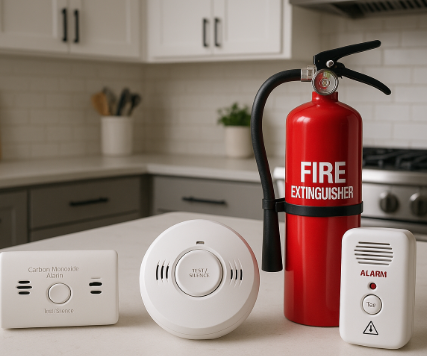
A single, aging smoke alarm in the hallway is insufficient. Modern safety standards require a multi-layered detection network .
Interconnected Alarms: If a fire starts in the basement, the alarm in the master bedroom should sound simultaneously. Modern wireless interconnected alarms make this possible without rewiring the house.
Dual-Sensor Technology: Use alarms that combine Ionization (fast for flaming fires) and Photoelectric (fast for smoldering, smoky fires) sensors.
Fire Extinguisher Mastery: Remember the P.A.S.S. acronym: P ull the pin, A im at the base, S queeze the trigger, S weep side to side. Every home should have a minimum of one 2.5lb ABC-rated extinguisher on every floor and one specifically in the kitchen.
Vulnerable Populations: Children and the Elderly
Safety awareness must be tailored to the occupants. Research shows that children often sleep through standard high-pitched smoke alarms because their brains are wired for deep REM sleep.
Vocal Alarms: Some modern alarms allow you to record your own voice. Children are far more likely to wake up to a parent’s recorded voice calling their name than a mechanical beep.
Assisted Exit: For elderly family members with mobility issues, their bedroom should ideally be located on the ground floor near an exit, and local fire departments should be notified of their presence so they can be prioritized during a dispatch.
Conclusion: The Proactive Paradigm
Fire safety is not a "set-and-forget" task; it is a continuous audit of our living environment. It requires us to look at our homes through the lens of risk management—evaluating the age of our appliances, the materials in our furniture, and the readiness of our family members.
By shifting from a reactive mindset ("What do I do if there is a fire?") to a proactive one ("How do I engineer my home to resist fire?"), we significantly tip the scales in our favor. Knowledge is the most effective fire suppressant. When we understand the science of how things burn and the psychology of how we react, we transform a potential tragedy into a manageable risk.